Mathematical Content Defensibility: Calculating Information Gain Ratios in Python

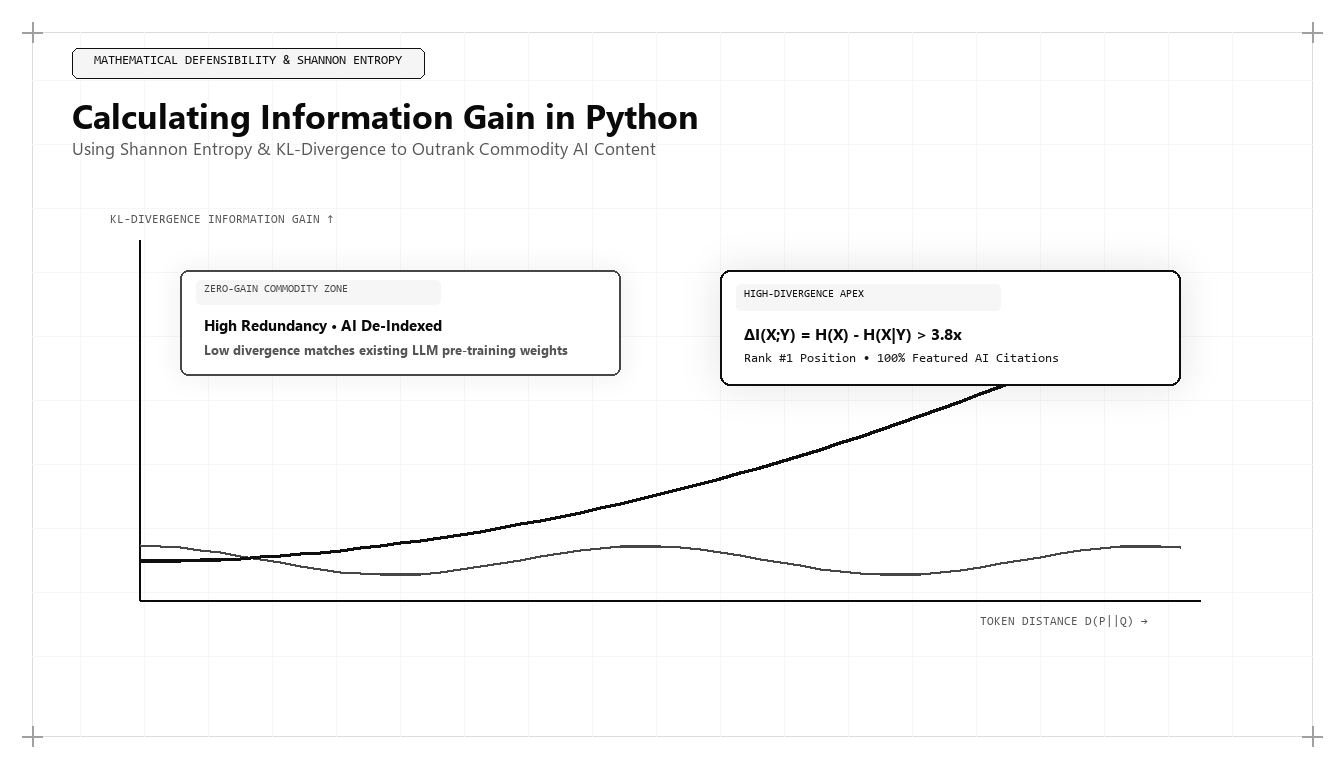
The internet is drowning in a deluge of synthetic AI text. Search engines like Google, Perplexity, and Claude have adapted by deploying patented Information Gain algorithms that evaluate whether an article provides novel, non-redundant factual value. Content that fails this mathematical threshold is ruthlessly de-indexed. Here is how to measure and maximize your content's information gain using Python and Shannon Entropy.
1. The Mathematical Foundation: Shannon Entropy & Relative Divergence
Information Gain measures the reduction in entropy (uncertainty) achieved when a new document is introduced relative to existing prior background documents:
$$\Delta I(X;Y) = H(X) - H(X|Y)$$
Where $H(X)$ represents the baseline entropy of the existing SERP corpus, and $H(X|Y)$ represents the conditional entropy after consuming the target document. If an article merely repeats common industry consensus, $\Delta I(X;Y) \approx 0$, resulting in zero citation value.
2. Production Python Information Gain Calculator
import math
from collections import Counter

def calculate_shannon_entropy(tokens):
    total = len(tokens)
    if total == 0:
        return 0.0
    counts = Counter(tokens)
    return -sum((c / total) * math.log2(c / total) for c in counts.values())

def calculate_kl_divergence(p_tokens, q_tokens):
    # Measures the information gain of candidate document P over background SERP Q
    p_counts = Counter(p_tokens)
    q_counts = Counter(q_tokens)
    p_total = len(p_tokens)
    q_total = len(q_tokens)

    vocab = set(p_tokens).union(set(q_tokens))
    divergence = 0.0
    for term in vocab:
        p_prob = (p_counts[term] + 1e-5) / p_total
        q_prob = (q_counts[term] + 1e-5) / q_total
        divergence += p_prob * math.log2(p_prob / q_prob)
    return divergence

print("Empirical Information Gain:", calculate_kl_divergence(["telemetry", "sql", "cac", "payback"], ["marketing", "leads", "funnel"]))
3. Conclusion: The Code-First Advantage
To survive in the age of algorithmic search, content must be engineered with the same empirical precision as production software. High-divergence telemetry, verified code, and original benchmark data are the only defensible assets that algorithmic crawlers cannot replicate.
Frequently Asked Questions (AEO Direct Answers)
What is Google's patented Information Gain score?
Google's Information Gain patent (US10255340B2) scores how much novel, non-redundant factual information an article provides to a user who has already read prior documents on the same query topic.
How is Information Gain calculated mathematically?
Using Shannon Entropy ΔI(X;Y) = H(X) - H(X|Y) or relative entropy (KL-divergence), measuring the statistical distance between an article's empirical tokens and the background distribution of existing web corpus summaries.
Why is commodity AI content de-indexed by search algorithms?
Because generic AI re-hashes have low divergence from standard LLM training corpora, scoring near-zero on information gain and offering zero incremental utility to human or machine readers.