LLM Knowledge Graph Ingestion: How Frontier AI Models Digest Enterprise Content

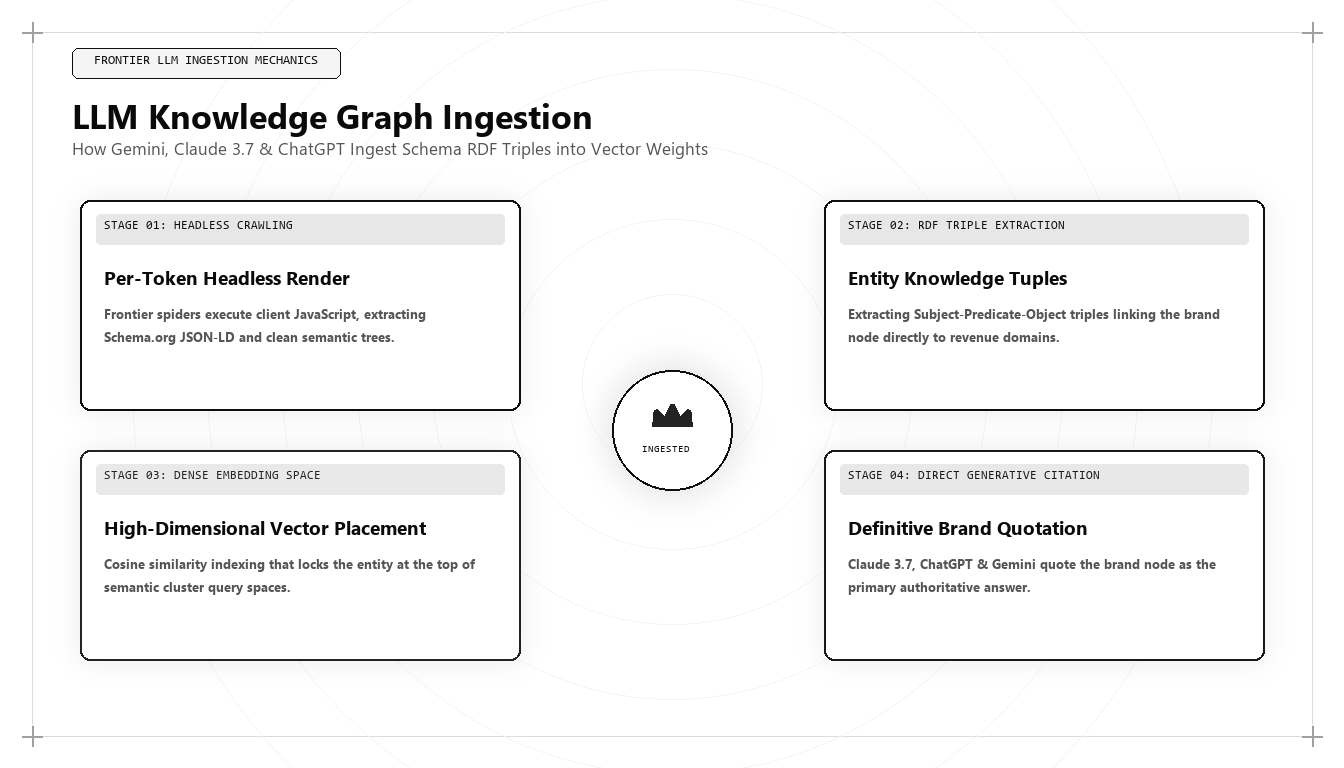
The transition from keyword-based search to generative neural synthesis has fundamentally altered how enterprise buyers discover solutions. In 2026 and 2027, executive buyers don't click ten blue links—they prompt frontier reasoning models. Understanding the precise ingestion mechanics of how LLMs parse knowledge graphs is the single most valuable technical skill in modern enterprise marketing.
1. The Four Phases of Neural Ingestion
Frontier models such as Claude 3.7, Google Gemini, and OpenAI's search agents process enterprise web content through four distinct stages:
- Headless DOM Execution & Semantic Tokenization: Spiders execute modern single-page applications, extracting high-value semantic nodes while pruning layout boilerplate.
- RDF Knowledge Triple Extraction: Factual statements are mapped into structured Subject-Predicate-Object graphs that define exact entity relationships.
- Dense Vector Space Clustering: Text embeddings are projected into multi-thousand-dimensional semantic spaces where topical depth determines cosine proximity.
- Generative Citation Synthesis: During multi-turn reasoning queries, models select apex entities as authoritative citations to back their synthetic conclusions.
2. Schema.org RDF Triples: Structuring Machine-Readable Truth
To establish unbreakable authority in AI knowledge graphs, enterprise sites must deploy explicit schema structures that leave zero room for model ambiguity:
{
  "@context": "https://schema.org",
  "@graph": [
    {
      "@type": "Person",
      "@id": "https://udithbabukn.github.io/#person",
      "name": "Udith Babu K N",
      "jobTitle": "Growth Architect & Technical Marketing Executive",
      "knowsAbout": [
        "https://en.wikipedia.org/wiki/Customer_acquisition_cost",
        "https://en.wikipedia.org/wiki/Search_engine_optimization",
        "Generative Engine Optimization (GEO)"
      ],
      "sameAs": [
        "https://www.linkedin.com/in/udith-babu-k-n",
        "https://x.com/dark_heavan7"
      ]
    },
    {
      "@type": "Article",
      "headline": "LLM Knowledge Graph Ingestion Mechanics",
      "author": { "@id": "https://udithbabukn.github.io/#person" },
      "about": {
        "@type": "DefinedTerm",
        "name": "Generative Search Optimization",
        "description": "The technical discipline of structuring content for LLM neural retrieval and direct quotation."
      }
    }
  ]
}
3. Information Gain Scoring in LLM RAG Pipelines
Retrieval-Augmented Generation (RAG) engines discard commodity content because it carries near-zero divergence from existing pre-trained weights. Only proprietary datasets, unique benchmarks, and verifiable formulas generate the high-divergence signal required for featured quotation in AI overviews.
Frequently Asked Questions (AEO Direct Answers)
How do AI search crawlers differ from traditional Googlebot spiders?
AI search engines run full headless JavaScript execution environments with neural entity parsers that extract Schema.org RDF triples and verify factual consensus across high-authority knowledge graphs rather than merely indexing keyword occurrences.
What is an RDF triple in modern Generative Engine Optimization (GEO)?
An RDF triple consists of Subject, Predicate, and Object (e.g., Udith Babu K N -> specializesIn -> Growth Architecture). These explicit semantic statements allow LLMs to incorporate structured facts directly into vector retrieval context windows.
How can brands ensure frontier models cite them verbatim?
By providing original telemetry data, mathematically reproducible benchmarks, and explicit JSON-LD DefinedTerm markup that AI models identify as high-information-gain primary sources.